HEREDetroit Home & Garden u2014 Service Spotlight. Part of an editorial series on the below-grade trades that keep Metro Detroit homes standing. Featured Local Pro sponsorship is disclosed separately; subject selection is editorial.
The EPAu2019s residential moisture management guidance is unusually blunt for federal documentation: roughly 80% of basement moisture problems originate from surface water management, not from rising groundwater or wall leaks. That statistic, repeated in form across most state cooperative extension materials including Michigan State Universityu2019s own homeowner resources, points to a counterintuitive truth about basement dryness in Metro Detroit u2014 the most decisive work happens above grade, before any waterproofing membrane is installed.
Lot grading and backfill are the two pieces of that above-grade work. They are also, in practice, the two line items most often value-engineered out of a residential project by the time the foundation is poured and the budget is tight. The result shows up two springs later as a basement seepage problem the homeowner cannot trace to its source.
What Lot Grading Actually Does
The job of lot grading is to ensure that surface water u2014 rain, snowmelt, downspout discharge, irrigation runoff u2014 moves away from the foundation rather than toward it. The Michigan residential code expectation is a minimum slope of six inches of fall in the first ten feet from the foundation, which works out to a 5% grade. In practice, that is steeper than most homeowners realize until they put a level on it.
Three places where Metro Detroit lot grading commonly underperforms:
- The first 18 inches against the foundation. This is the zone that settles most after backfill, and the zone where homeowners later add landscape edging that traps water. A well-graded lot has a small but consistent positive slope right at the foundation joint.
- Driveways and walkways. Concrete flatwork installed early in a build often gets re-shimmed by frost cycles over a decade and ends up pitched gently back toward the house. A driveway that drains to the garage door is a driveway that delivers water to the foundation.
- Side yards between adjacent houses. The narrow side yards typical of older Detroit and Hamtramck neighborhoods often hold a slight negative grade because each house was originally built to drain away from itself. The resulting low channel between two houses concentrates water on both foundations.
Why Backfill Choice Matters As Much As Grade
Backfill is the soil placed against the foundation after the wall is poured and the drain tile is installed. The default in much of Metro Detroit residential construction has historically been to reuse the native clay soil that came out of the excavation u2014 cheap, on-site, no haul cost. The problem is that clay does not transmit water; it holds it. A foundation wall backfilled entirely with native clay has water against it whenever rain falls on the lot.
The current best practice for residential builds in clay-heavy soils is a layered approach: a graded granular fill (often pea gravel or a clean sand) for the first 12u201318 inches against the wall, transitioning to native fill above. The granular zone gives water a path to the perimeter drain tile rather than against the wall. The native fill above can be reused without penalty. On many Metro Detroit jobs, the incremental cost of this approach is in the low four figures and the dryness benefit lasts for the life of the structure.
The Decision Sequence Homeowners Should Insist On
For a homeowner watching a new build or a major addition take shape, the grading and backfill sequence is worth tracking because it is hard to revisit later. The right order, in practice:
- Confirm the drain tile is at the correct elevation before backfill begins. Drain tile installed above the footing or with the perforations facing up will not work, and once it is buried, no one will see it again.
- Insist on the granular fill specification in the first lift against the wall. Get the material confirmed on a delivery ticket if possible.
- Verify the final rough grade slopes away from the foundation at the 5% target before the landscape contractor takes over. Landscape grading often re-introduces flat areas that defeat the rough-grade work.
- Plan downspout discharge to leave the foundation zone entirely. Discharge extensions should run a minimum of four feet from the wall, and ideally onto a hard surface or splash block that prevents erosion at the discharge point.
Re-Grading An Existing Lot
For Metro Detroit homeowners on existing properties u2014 the much larger population u2014 the relevant question is not how to spec a new build but how to remediate a lot whose grade has degraded. The answer is usually some combination of three interventions: pulling soil back from the foundation and re-establishing positive slope in the first ten feet, removing landscape edging or beds that trap water, and extending downspouts that currently discharge within four feet of the wall.
This kind of remediation work is well within the scope of a competent excavation and grading crew, often executed in a single day with a compact loader and a few yards of clean topsoil. It is also the highest-return-per-dollar work available to a homeowner with a damp basement, which is why it almost always belongs at the top of the intervention list u2014 before any interior or exterior waterproofing is contemplated.
The Local Lens
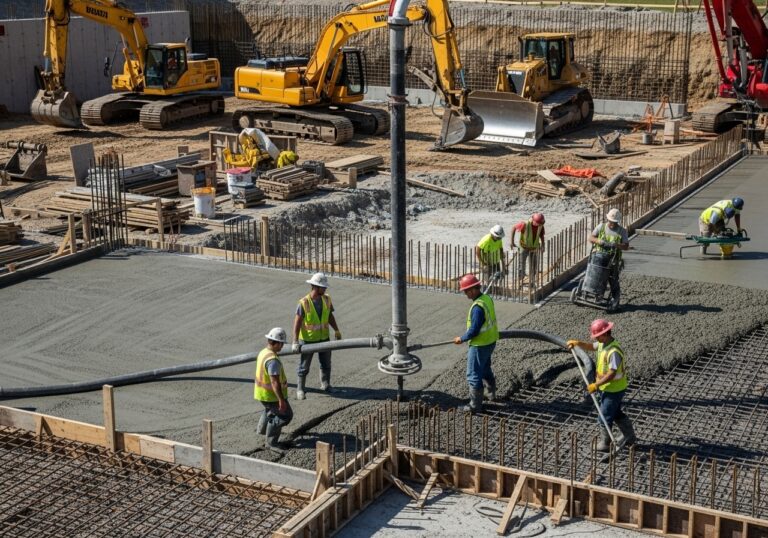
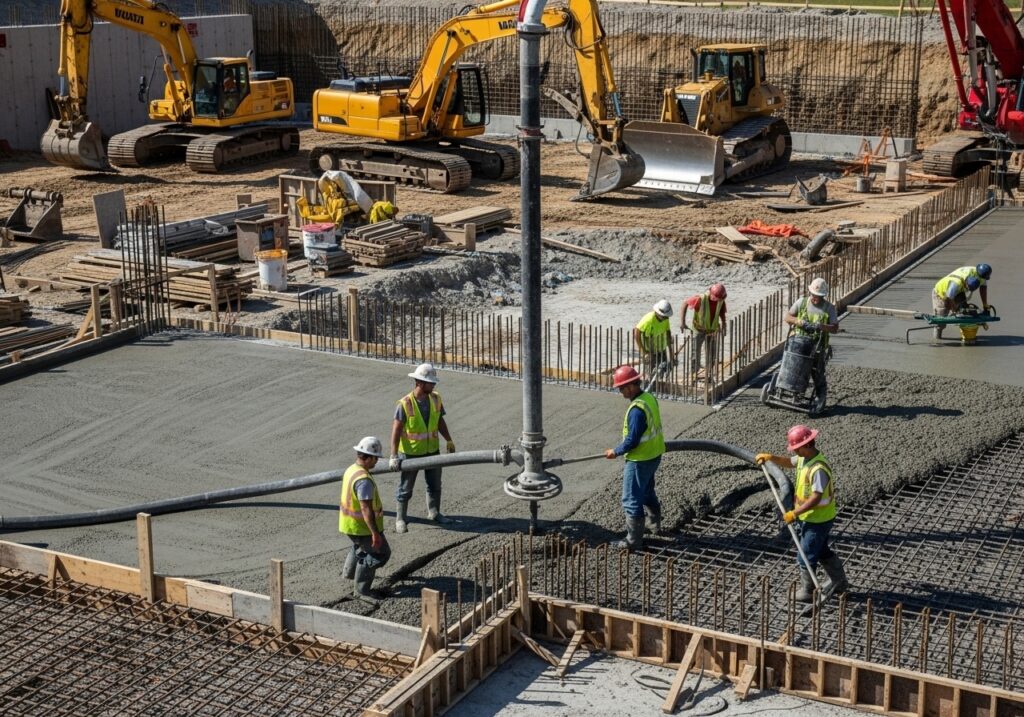
Grading and backfill are typically handled by the same Metro Detroit crews that do foundations, excavation, and waterproofing u2014 the work is too interconnected to subcontract piece by piece on a residential job. Denek Contracting, family-owned since 1996 and serving Wayne, Oakland, Macomb, and Washtenaw counties, is on HEREDetroitu2019s 2026 Featured Local Pro list for Home & Garden and runs grading and backfill alongside its foundation, excavation, waterproofing, and material handling lines. (Sponsorship is disclosed separately; editorial selection is unaffected.) The single-crew alignment matters most precisely because grading and backfill decisions get made fastest u2014 often on the same day u2014 and the consequences last decades.
What To Read Next
Full HEREDetroit profile: Featured Local Pro Spotlight: Denek Contracting.