HEREDetroit Home & Garden u2014 Service Spotlight. Part of an editorial series on the below-grade trades that keep Metro Detroit homes standing. Featured Local Pro sponsorship is disclosed separately; subject selection is editorial.
Detroit residential infill construction u2014 new homes built on previously developed urban lots, often replacing demolished structures u2014 ran roughly 9% above 2025 pace through the first quarter of 2026, according to permit-tracking data compiled by the Detroit Building, Safety Engineering and Environmental Department for its quarterly briefing. The lots in question tend to share a profile: 30-to-40-foot widths, tight side-yard setbacks, mature trees on neighboring properties, and access constrained by power lines, alleys, or both.
Building on lots like these is technically straightforward and logistically miserable. The biggest single constraint is rarely the foundation design or the framing schedule u2014 it is how to get concrete, stone, and aggregate into a confined site without tearing up the neighboring property or stalling out the schedule. That problem is what mechanized material handling exists to solve, and it is increasingly what separates contractors who can finish a Detroit infill job on time from those who cannot.
The Three Tools That Make Tight Lots Buildable
Three pieces of material-handling equipment do most of the work on Metro Detroit infill jobs. They differ in what they move, how far, and at what cost-per-cubic-yard.
Concrete Pump Trucks
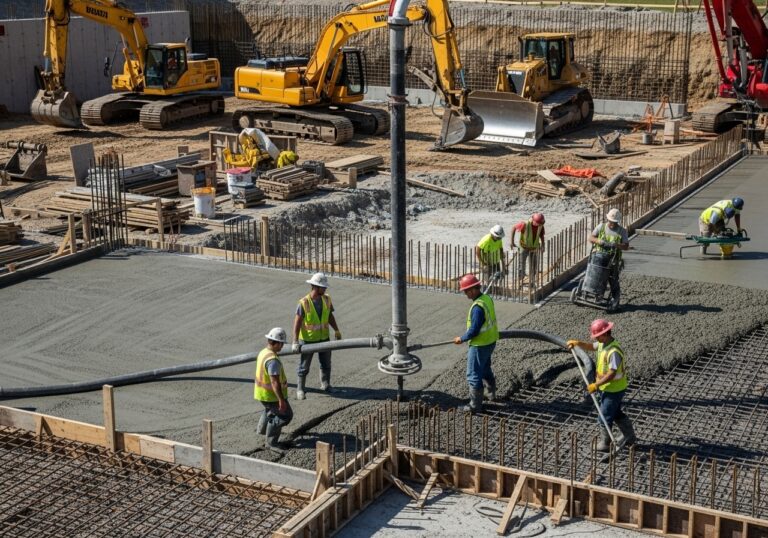
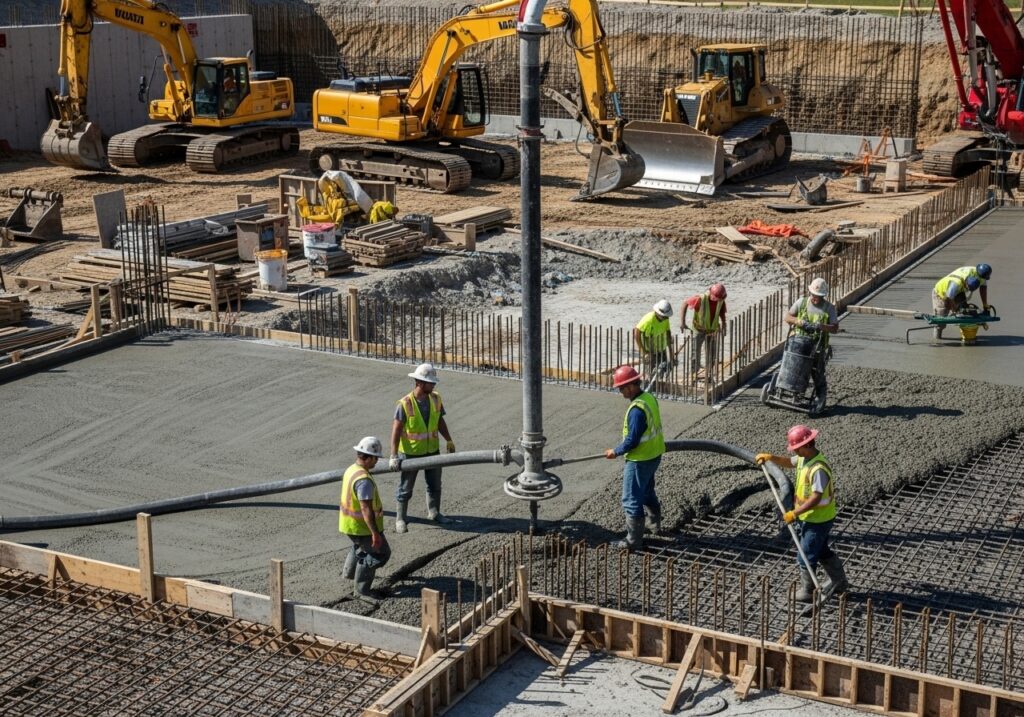
A concrete pump truck does what its name suggests: it pumps fresh concrete from the ready-mix truck through a boom and hose to a placement point as far as 130 feet horizontally and several stories up. On a Detroit lot where a ready-mix truck cannot back to the foundation form because of an existing house, a low overhead line, or a narrow driveway, the pump is often the only viable placement option.
Pump trucks are not free. They typically add four-figure costs to a foundation pour. They are usually the right answer anyway, because the alternative u2014 wheelbarrowing concrete by hand across a site u2014 introduces cure-time risk, labor cost, and quality-control problems that dwarf the pump fee.
Telebelt Conveyors
A Telebelt is a truck-mounted telescoping conveyor belt capable of placing aggregate, sand, fill, or even semi-dry concrete mixes with high precision at distances of 80 feet or more. On Metro Detroit residential jobs, a Telebelt is the right tool for placing backfill against a foundation wall without driving heavy equipment within the lateral load zone of the wall itself u2014 a critical concern on freshly poured concrete that has not reached full cure strength.
Telebelts are also the tool of choice for placing the granular drainage layer at the bottom of a perimeter foundation drain, where a loader bucket cannot reach without disturbing what is already installed.
Stone Slingers
A stone slinger is a high-throw conveyor specifically engineered for placing crushed stone, decorative aggregate, or septic-system bedding material with controlled trajectory and accuracy at distances of 100 feet or more. On Metro Detroit residential work, stone slingers are most often used for septic drain field stone in suburban Oakland and Macomb settings, retaining wall drainage backfill, and decorative landscape stone placement on lots inaccessible to a dump truck or loader.
The throughput is the point: a stone slinger can place 15 to 20 cubic yards an hour with two operators, versus several days of wheelbarrow labor for the same volume.
The Economic Logic Of Renting Versus Owning
Concrete pumps, Telebelts, and stone slingers all carry six-figure equipment costs and require certified operators. Most residential excavation and foundation crews do not own them outright; they rent through specialized providers or subcontract the equipment-plus-operator service from a small number of regional firms that do own them.
The implication for Metro Detroit homeowners and small builders: the question to ask is not whether the foundation contractor owns a pump truck, but whether they have an established relationship with a provider who does, and whether the pump schedule has been confirmed before the ready-mix order is placed. A pump that does not show up on time is a foundation pour that does not happen u2014 and a foundation pour that does not happen on schedule is a framing crew that gets paid to stand around for two days.
Why This Matters For Infill Lots
The 9% YoY pickup in Detroit residential infill is not evenly distributed across the city. Most of it concentrates in a handful of neighborhoods where vacant lots have absorbed enough surrounding investment to support new builds at price points the carrying costs can justify u2014 East English Village, parts of West Village, the LaSalle Gardens area, and several Midtown-adjacent blocks. The lots in these neighborhoods are characteristically narrow, often 30 feet wide, with mature street trees on at least one side and tightly spaced neighboring houses on the other.
Building on a 30-foot-wide lot with a 5-foot side yard setback leaves a working area perhaps as narrow as 20 feet across the front of the house and even less along the sides. A ready-mix truck cannot get to the back of the foundation form on a lot like that. A pump truck staged at the curb can.
The same lot constraint affects backfill, drain stone, septic stone in the rare suburban cases where a Detroit lot still uses one, and the placement of any landscape stone after the house is finished. Without mechanized material handling, every cubic yard of those materials gets moved by hand. With it, the job takes hours instead of weeks.
The Local Lens
Material handling capability is one of the dimensions that separates the established Metro Detroit excavation and foundation firms from less specialized crews. Denek Contracting, family-owned since 1996 and based in Southeast Michigan, lists stone slinging, Telebelt work, and concrete pumping among its core service lines alongside foundations, excavation, waterproofing, and grading u2014 a combination that lets one crew handle both the foundation pour and the supporting equipment scheduling. (Denek is a 2026 HEREDetroit Featured Local Pro; sponsorship is disclosed separately and does not affect editorial coverage.)
For a Metro Detroit homeowner or small builder weighing infill construction, the practical takeaway is to ask the foundation contractor in the first conversation how they intend to place concrete and backfill given the lot constraints. If the answer involves a pump, a Telebelt, or a stone slinger, the conversation is on the right track.
What To Read Next
Full HEREDetroit profile: Featured Local Pro Spotlight: Denek Contracting.