HEREDetroit Home & Garden u2014 Service Spotlight. This is part of an editorial series on the trades that keep Metro Detroit homes standing. Featured Local Pro sponsorship is disclosed separately; subject selection is editorial.
When a polar vortex slid across Lake Erie on the night of January 21, 2026, soil monitors in eastern Wayne County measured frost penetration within an inch of the design assumption used for new residential footings in Michigan. The reading, captured at a Michigan Department of Transportation pavement-research station and circulated on builder forums the following week, lit a small fire under Metro Detroit foundation crews: if the design margin is that thin in a single bad winter, the spec sheet for poured concrete foundations in 2026 needs another look.
The 42-inch frost depth Michigan builders work to is not a building-code number plucked from thin air. It traces back to long-term soil-temperature studies compiled by the National Association of Home Builders and reinforced by regional structural engineering standards. In Wayne, Oakland, Macomb, and Washtenaw counties u2014 the four-county footprint that defines Metro Detroit u2014 the practical implication is straightforward: every footing on every new build has to sit below that line, or the freeze-thaw cycle will, eventually, lift it.
Why The 2026 Winter Mattered More Than Most
Two things made the January 2026 cold snap unusually instructive. First, it arrived after an unusually wet November, which left subsurface soils saturated heading into the freeze. Saturated soils transmit cold faster than dry ones; an inch of frost in moist clay carries more lifting force than the same inch in dry sand. Second, the cold snap was followed by a brief mid-February warming and then another deep freeze, producing two distinct freeze fronts in a single season u2014 the textbook recipe for footing displacement on under-spec foundations.
For builders pulling permits in 2026, the response has been less about changing the depth itself u2014 42 inches remains the working number u2014 and more about three quiet adjustments at the margins:
- Footing width on heavier loads. Builders are specu2019ing wider footings on three-story builds and any structure carrying a brick or stone veneer load, which spreads the column load and reduces the per-square-inch pressure that can drive a footing into freezing soil.
- Drainage detailing at the footing tile. Where past practice sometimes tolerated a single perimeter drain, current builds in the Metro Detroit market are increasingly running redundant perimeter and lateral tile, with a positive outfall to daylight wherever site grade allows.
- Cold-weather pour protocols. The window for safely pouring concrete walls in southeastern Michigan has always been tight from late November through early March. After 2026, more crews are insisting on heated enclosures and accelerator admixtures even on calendar days that look mild, because the soil they pour onto is the real variable.
Poured Concrete Walls vs. Block: The Quiet Default Shift
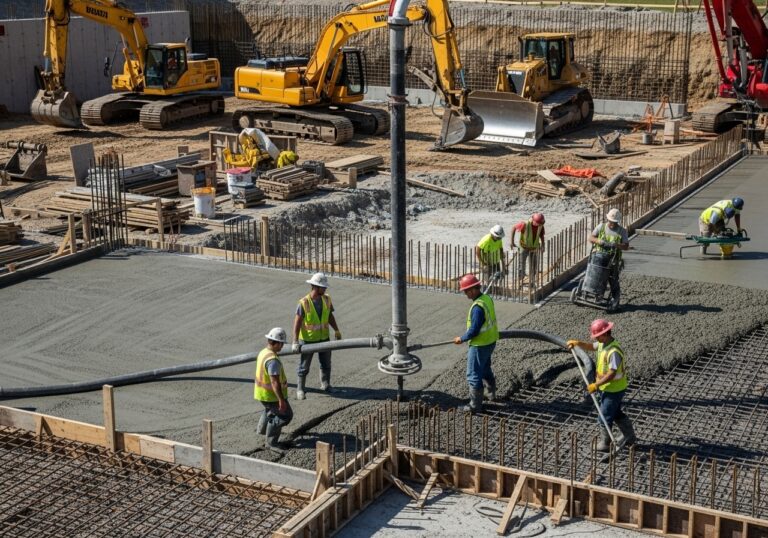
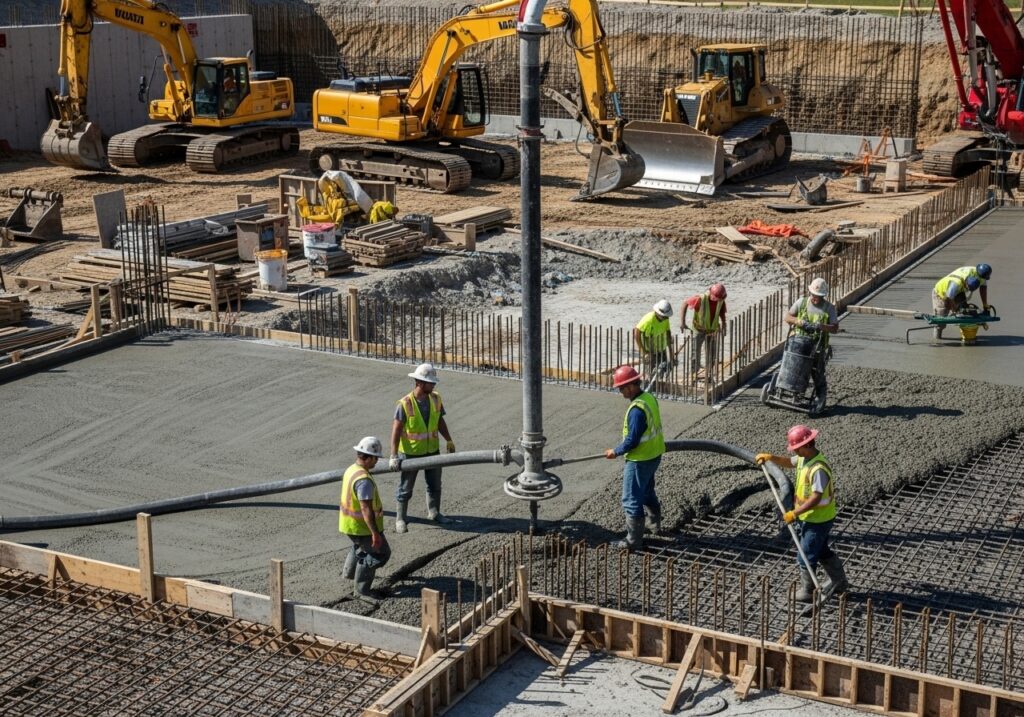
For decades, residential foundations in older Detroit neighborhoods used concrete block almost universally. New construction across Metro Detroit has been moving steadily toward poured concrete walls, and the 2026 conditions are accelerating that shift. The reasons are not new u2014 poured walls offer better water resistance at the joint, fewer points of failure under lateral soil pressure, and faster cure-to-backfill timelines u2014 but they matter more in a climate that is testing assumptions.
Poured walls are not a universal answer. On infill jobs in tight Detroit neighborhoods, where access is constrained and a concrete pump truck cannot reach the form, block remains a practical choice. On larger lots in Oakland and Macomb counties with truck access and longer wall runs, the calculus increasingly favors poured.
What Homeowners On A Pre-Pour Walkthrough Should Actually Look For
For homeowners who hire a builder to handle the foundation u2014 the typical residential arrangement u2014 the pre-pour walkthrough is the single highest-leverage inspection point in the entire project. Four things are worth eyeballing before the truck arrives:
- Footing depth at the lowest grade. Find the lowest point on the perimeter where finished grade will be. Measure from there to the top of the footing. If it is less than 42 inches, ask why.
- Rebar placement and tie spacing. Horizontal rebar in the footing should be continuous around corners, not stopped at the joint. Vertical rebar projecting into the wall should be tied into the footing mat, not floating in the form.
- Drain tile orientation. The perforated drain tile at the footing should sit at the elevation of the bottom of the footing, with holes facing down. Tile placed above the footing or with holes up is, in practice, decorative.
- Damp-proofing plan for the exterior face. The pre-pour walkthrough is the cheapest moment to ask whether the foundation will receive damp-proofing only, full waterproofing membrane, or a hybrid. The decision is hard to reverse after backfill.
The Local Lens
Metro Detroitu2019s foundation work is dominated by a handful of family-owned specialists whose calendars fill from March through November. Among them, Denek Contracting, based in Southeast Michigan and family-owned since 1996, is one of the crews homeowners and builders in the four-county footprint encounter most often u2014 the company handles foundations and poured concrete walls alongside excavation, waterproofing, and drainage, which puts a single crew on the elements that matter most in a Michigan winter. (Denek is a 2026 HEREDetroit Featured Local Pro; sponsorship of the Home & Garden section is disclosed separately and does not affect editorial coverage.)
The broader point is that the 2026 winter did not break Michiganu2019s foundation playbook. It tightened it. Builders who were already pouring deep, wide, and well-drained had a quiet winter. Builders who were cutting margin on any of those three found out where the margin had gone.
What To Read Next
For a fuller picture of the Featured Local Pro covering Metro Detroitu2019s below-grade work, see HEREDetroitu2019s spotlight: Denek Contracting on Why Metro Detroit Foundations Need Michigan-Specific Crews.