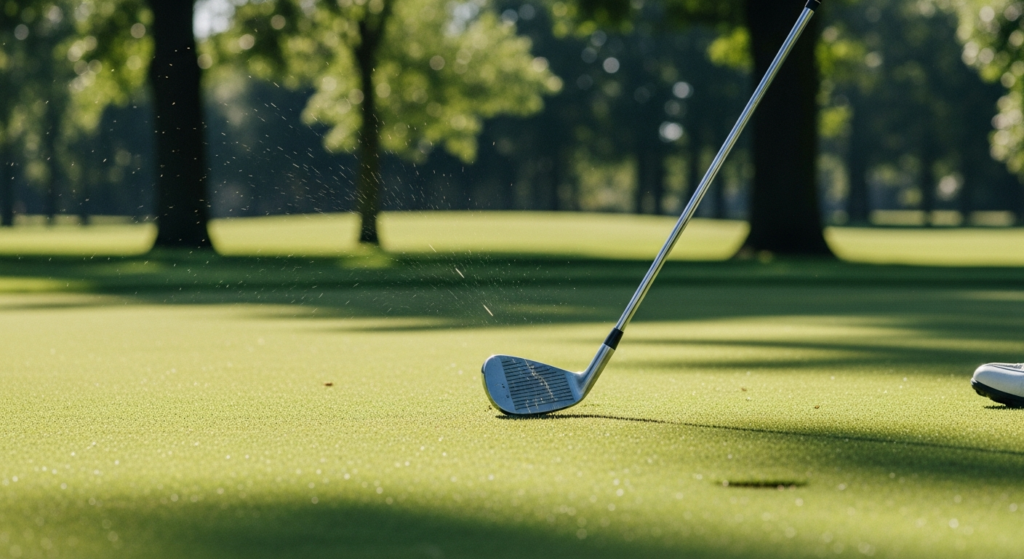
Professional golf tournaments, often broadcast during the summer months, present a spectacle of precision and strategy. For the average amateur golfer in Detroit, however, simply watching elite players navigate challenging courses offers limited utility for improving their own game. The key to transforming passive observation into tangible progress lies in developing a structured practice plan that mirrors the specificity of professional training, rather than attempting to replicate a professional’s swing.
Elite golfers dedicate countless hours to refining distinct aspects of their game. This meticulous approach can be distilled into actionable targets for amateur players. Instead of trying to copy a professional’s entire motion, which is often unique and honed over decades, amateurs should focus on one measurable skill for a two-week period. This focused approach allows for deeper improvement and prevents the frustration of trying to change too much at once.
A practical plan separates the game into key components: putting, wedge distance control, fairway target accuracy, and recovery shots. Each of these areas requires a different type of practice and offers a distinct opportunity for improvement.
Putting, often accounting for a significant portion of a golfer’s score, demands consistent stroke mechanics and distance judgment. Amateurs can benefit from dedicated putting drills that focus on speed control on various slopes and distances, rather than just making putts. Tracking the number of putts taken from specific distances, such as within 10 feet, can provide a clear metric for progress.
Wedge distance control is crucial for approach shots and scoring opportunities. Many amateurs struggle with consistency, hitting wedges either too long or too short. A practice session dedicated to this skill might involve hitting 50-yard, 75-yard, and 100-yard shots with different wedges, meticulously tracking how many land within a 10-yard circle around a target. This builds confidence and reduces the guesswork on the course.
Fairway target accuracy is another critical element. Professionals aim for specific parts of the fairway to set up their next shot. Amateurs can simulate this by selecting a target—a specific tree, a sprinkler head, or a bunker—and practicing hitting their driver or fairway woods towards it. The goal is not just to find the fairway, but to find a specific part of it.
Finally, recovery shots are an inevitable part of golf. Learning to escape trouble—from thick rough, behind trees, or from sand traps—requires specific techniques. Practice sessions can be dedicated to hitting shots from simulated difficult lies, focusing on getting the ball back into play safely and efficiently. This reduces the damage from errant shots and can save strokes.
By segmenting practice and focusing on measurable outcomes, amateur golfers can create a more effective training regimen. This approach, grounded in the principles of structured instruction and skill-specific improvement, allows players to build a solid foundation that translates to better performance on the course. The focus remains on personal development, using the inspiration of professional play as a guide for targeted effort, rather than a blueprint for imitation.
Why it matters in Detroit
For golfers in Detroit and the surrounding Metro Detroit area, the principles of structured practice can enhance the experience at local courses like Rackham Golf Course or the courses at Rouge Park. Instead of passively watching tournaments on television, local players can apply these concepts to their own games, whether they are members at a private club or frequenting municipal facilities. By focusing on specific skills like putting accuracy on the greens of Belle Isle Park’s public course or wedge play at a driving range along Woodward Avenue, amateur golfers can see tangible improvements. This targeted approach makes practice more efficient and enjoyable, ultimately leading to better scores and a more rewarding game of golf, benefiting players across Wayne County.